Gut Health
Original article by Dr Lyn Thomson, founder of Raw Essentials.
Lyn was an early advocate for the importance of gut health in animal wellbeing. At the time the original article was written, the microbiome received far less attention than it does today. Research has since expanded rapidly, and our understanding of dysbiosis, intestinal permeability and their relationship with wider health continues to evolve.
Why Gut Health Matters
Gut health matters far beyond digestion.
The gut is a major meeting point between the body and the outside world. It digests and absorbs nutrients, houses a large and active microbial community, communicates with the immune system and helps form a protective barrier between the contents of the gut and the rest of the body.
When this complex system is working well, it supports digestion, nutrient availability, immune balance and resilience.
When the microbial community or intestinal barrier is disrupted, the effects may reach far beyond the gut. These relationships are complex and can work in both directions, reinforcing why food and gut health are central to the Raw Essentials approach.
Meet the Gut Microbiome
The gut microbiome is the vast community of bacteria, fungi, viruses and other microorganisms living within the digestive tract.
These microbes are not simply passengers. Collectively, they help:
digest and transform nutrients;
produce vitamins and other useful compounds;
influence the immune system and inflammation;
produce metabolites such as short-chain fatty acids;
support the mucus layer and intestinal barrier;
transform bile acids;
protect against inappropriate bacterial overgrowth;
communicate with other organs, including the brain, kidneys and heart.
We are still learning what an ‘ideal’ microbiome looks like in dogs and cats. What we do know is that a balanced, functional and resilient microbial community matters.
And it is not as simple as dividing bacteria into ‘good bugs’ and ‘bad bugs’. A microorganism may be perfectly useful in one situation, but problematic if it becomes too numerous or grows where it should not.
How Your Pet Digests Food
Digestion is a complex, coordinated process.
Food begins to be broken down as it is eaten, then enters the stomach where it mixes with hydrochloric acid and gastric juices. This acidic mixture moves into the small intestine, where digestive enzymes from the pancreas and bile from the gallbladder help break food down further.
Gut microbes also contribute to digestion. Once food has been broken into smaller components, nutrients can be absorbed across the intestinal lining. Material that remains moves into the large intestine, where microbes may ferment it and produce useful metabolites, or it is eventually passed as faeces.
For this process to work well, the gut environment needs to be healthy. Stomach acidity, digestive secretions, the intestinal lining and the microbial community all work together.
The digestive process is a production line. If the first person in the line is not doing their job properly, there is little hope of the rest of the line working at its best.
Disruption early in the digestive process can therefore have effects further along the digestive tract.
When the Balance Is Disturbed: Dysbiosis
Dysbiosis describes a disruption in the normal gut microbial community. This may involve losing important organisms, gaining others, or changes in the relative numbers and activity of different microbes.
These changes matter because the microbiome produces substances that interact directly with the gut lining, immune system and the rest of the body.
Dysbiosis commonly accompanies gastrointestinal disease, but changes in the microbiome have also been identified in dogs and cats with a growing range of other health conditions.
Importantly, the relationship can work both ways.
Disease, inflammation or poor digestion may contribute to dysbiosis, while dysbiosis may in turn influence inflammation, nutrient absorption and gut-barrier health. In an individual animal it is not always possible to say which came first.
Increased Intestinal Permeability, or ‘Leaky Gut’
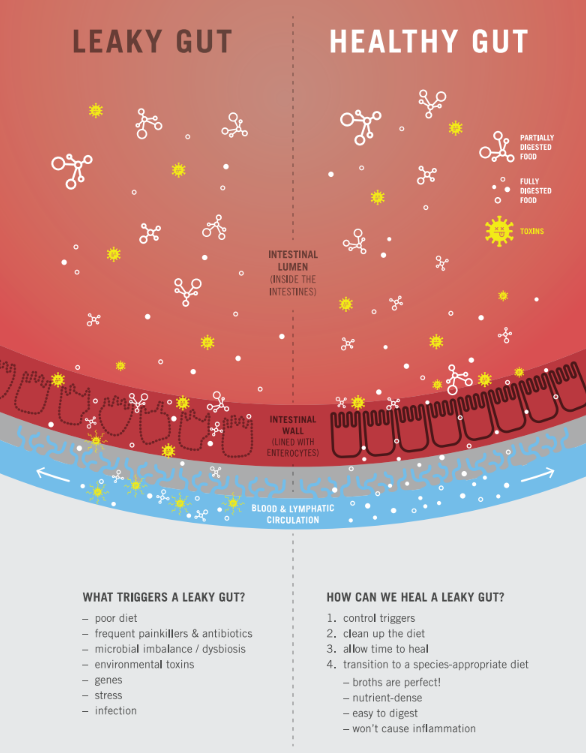
The intestinal lining is not supposed to be an impenetrable wall. It is a highly selective barrier.
It needs to allow digested nutrients to pass into the body while helping keep pathogens, toxins and larger inappropriate particles where they belong.
The cells lining the intestine are connected by structures often described as tight junctions. Inflammation and changes within the gut environment can interfere with this barrier, loosening these junctions and allowing intestinal permeability to increase. This is commonly referred to as ‘leaky gut’.
Dysbiosis, inflammation and increased intestinal permeability are closely connected and may reinforce one another.
This state of dysfunction can have far-reaching effects throughout the body, reinforcing why a healthy intestinal environment and strong gut barrier are so important to wider health and wellbeing.
The gut is local. Its influence is not.
Spare a Thought for the Gut
Gut health does not sit in isolation. When supporting an animal with a chronic or complex health condition, it is worth considering what may also be happening in the gastrointestinal tract.
Research continues to identify links between the gut microbiome, intestinal barrier and health beyond the digestive system. These relationships may work in both directions, and gut dysfunction is not necessarily the cause of the condition. But supporting digestion and gut health can still form an important part of the wider nutritional picture.
Allergies and Itchy skin | Gut–brain axis and behaviour | Kidney disease | Diabetes | Pancreatic disease | Urinary health | Obesity
When looking at the whole animal, spare a thought for the gut.
What Can Disrupt Gut Health?
The microbiome is constantly responding to what is happening around and within the animal.
Some influences begin very early. Genetics, maternal nutrition, the birth process and early feeding can all help shape the developing microbiome.
Later influences may include:
diet and major dietary changes;
antibiotics and some other medications;
digestive illness and inflammation;
infection and parasites;
stress and anxiety;
obesity;
ageing;
environmental exposures.
Antibiotics can sometimes be essential and life-saving, but they can also have significant effects on the intestinal microbiome. Some studies in dogs have shown changes persisting for weeks or even months after treatment has finished.??
This is not a reason to avoid necessary medication. It is a reason to recognise that the gut may need support before, during or after periods of disruption.
Our Smart Parasite & Disease Prevention page explores practical ways to use the right intervention, at the right time, for the right reason.
Food Matters
Food is one of the most powerful things we can influence.
Diet affects digestion, gastric secretions, nutrient availability and the substrates reaching the microbial community further down the gastrointestinal tract. Studies in dogs and cats show that changes in dietary protein and carbohydrate can alter the gut microbiome.
Meat protein also stimulates gastric acid secretion. Strong stomach acidity plays important roles in protein digestion, nutrient release, signalling further digestive processes and helping protect against inappropriate microbial growth.
At Raw Essentials, we start with a clean, species-appropriate diet based on minimally processed prey-based foods. animal foods.
We remove grains, starches, additives and preservatives and focus on providing meat, bone and organs in appropriate proportions, with variety tailored to the individual.
Whole foods also provide nutrients within their natural food matrix, alongside the proteins, fats, minerals, vitamins and cofactors with which they naturally occur.
Keep it simple. Start with the foundations.
Sometimes improving gut health is not about adding more products. It begins with removing foods that may be difficult for that individual animal to manage, and providing foods their digestive system is well equipped to use.
Different animals respond differently, so the individual response always matters.
Supporting Gut Recovery
When gut health is compromised, we start with the food.
Every animal is different. Some tolerate dietary changes easily, while others with sensitive or disrupted guts need a much gentler approach. Our aim is to reduce unnecessary dietary stress, support digestion and give the gut the best opportunity to recover.
For some pets, we use our Gut Healing Protocol, beginning with a very simple, easily digested diet of poached lean meat and bone broth, before gradually introducing appropriate raw foods as the animal’s digestion settles. This gives us a chance to simplify what is going into the gut, monitor the response and rebuild the diet step by step.
We also consider the wider picture. Food intolerances or trigger proteins, poor digestion, malabsorption, previous medications and underlying disease may all influence how well an animal responds.
Probiotics and other nutritional supports can sometimes be useful, but they are not one-size-fits-all. Different organisms and products have different effects, and some animals tolerate particular products better than others. Rather than simply trying to add more ‘good bacteria’, the goal is to help create a gut environment in which a healthy microbial community can function well.
We aim for root-cause resolution wherever possible. That means identifying and addressing the factors that may be disrupting the gut, rather than simply managing the symptoms.
Pets with significant, persistent or recurrent digestive problems may also need veterinary investigation and treatment.
The Raw Essentials Approach
The microbiome is extraordinarily complex and there is still much we do not know.
But the message is becoming increasingly clear: the gut matters.
Nutrition, digestion, microbes, the intestinal barrier and the immune system all interact. Supporting one part of this system may influence others.
Our aim is to provide the foundations for the healthiest gut we can: appropriate whole foods, excellent digestion, microbial resilience and nutrition suited to the individual animal.
As Lyn recognised many years ago, good health starts with respecting the gut.
Food first. Keep it simple. Support the gut and let the body do what it does best.
Further reading
Research into gut health is rapidly evolving. The following articles provide selected further reading on the microbiome, diet, digestion, intestinal barrier function and wider health. They are not intended to represent a complete review of the scientific literature.
Gut microbiome and dysbiosis
Suchodolski JS. Analysis of the gut microbiome in dogs and cats. Vet Clin Pathol. 2022;50(Suppl 1):6-17. doi:10.1111/vcp.13031.
Wernimont SM, Radosevich J, Jackson MI, et al. The effects of nutrition on the gastrointestinal microbiome of cats and dogs: impact on health and disease. Front Microbiol. 2020;11:1266. doi:10.3389/fmicb.2020.01266.
Ziese AL, Suchodolski JS. Impact of changes in gastrointestinal microbiota in canine and feline digestive diseases. Vet Clin North Am Small Anim Pract. 2021;51(1):155-169. doi:10.1016/j.cvsm.2020.09.004.
Butowski C, Moon C, Thomas D, Young W, Bermingham E. The effects of raw-meat diets on the gastrointestinal microbiota of the cat and dog: a review. N Z Vet J. 2022;70(1):1-9. doi:10.1080/00480169.2021.1975586.
Diet and the gut microbiome
Li Q, Lauber CL, Czarnecki-Maulden G, Pan Y, Hannah SS. Effects of the dietary protein and carbohydrate ratio on gut microbiomes in dogs of different body conditions. mBio. 2017;8(1):e01703-16. doi:10.1128/mBio.01703-16.
Li Q, Pan Y. Differential responses to dietary protein and carbohydrate ratio on gut microbiome in obese versus lean cats. Front Microbiol. 2020;11:591462. doi:10.3389/fmicb.2020.591462.
Bermudez Sanchez S, Pilla R, Sarawichitr B, et al. Fecal microbiota in client-owned obese dogs changes after weight loss with a high-fiber-high-protein diet. PeerJ. 2020;8:e9706. doi:10.7717/peerj.9706.
Digestion, gastric acid and intestinal protection
Heda R, Toro F, Tombazzi CR. Physiology, pepsin. In: StatPearls [Internet]. Treasure Island (FL): StatPearls Publishing; 2024.
Marks SL, Kook PH, Papich MG, Tolbert MK, Willard MD. ACVIM consensus statement: support for rational administration of gastrointestinal protectants to dogs and cats. J Vet Intern Med. 2018;32(6):1823-1840. doi:10.1111/jvim.15337.
Smith JL. The role of gastric acid in preventing foodborne disease and how bacteria overcome acid conditions. J Food Prot. 2003;66(7):1292-1303.
Hunt RH. The protective role of gastric acid. Scand J Gastroenterol. 1988;23(Suppl 146):34-39.
Gut health and wider disease
Fasano A. Zonulin and its regulation of intestinal barrier function: the biological door to inflammation, autoimmunity, and cancer. Physiol Rev. 2011;91(1):151-175. doi:10.1152/physrev.00003.2008.
Janeczko S, Atwater D, Bogel E, et al. The relationship of mucosal bacteria to duodenal histopathology, cytokine mRNA, and clinical disease activity in cats with inflammatory bowel disease. Vet Microbiol. 2008;128(1-2):178-193. doi:10.1016/j.vetmic.2007.10.014.
Blake AB, Guard BC, Honneffer JB, et al. Altered microbiota, fecal lactate, and fecal bile acids in dogs with gastrointestinal disease. PLoS One. 2019;14(10):e0224454. doi:10.1371/journal.pone.0224454.
Summers SC, Quimby JM, Isaiah A, et al. The fecal microbiome and serum concentrations of indoxyl sulfate and p-cresol sulfate in cats with chronic kidney disease. J Vet Intern Med. 2019;33(2):662-669. doi:10.1111/jvim.15389.
Kieler IN, Osto M, Hugentobler L, et al. Diabetic cats have decreased gut microbial diversity and a lack of butyrate-producing bacteria. Sci Rep. 2019;9:4822. doi:10.1038/s41598-019-41195-0.
Updated by Dr Rebecca Brown, BVSc
Veterinarian, Raw Essentials
Last updated: 24 August 2026
Raw Essentials | Wildly Good Advice & Nutrition

New Zealand's raw pet food experts
Locally sourced frozen raw pet food
Natural treats and freeze dried pet food
17 pet friendly stores across New Zealand
Nationwide raw pet food delivery
[email protected]
Copyright Raw Essentials Limited. All rights reserved.
RAW ESSENTIALS | Wildly Good Advice & Nutrition
New Zealand's raw pet food experts
Frozen raw, treats and freeze dried pet food
17 pet friendly stores across New Zealand
[email protected]
Copyright Raw Essentials Limited. All rights reserved.