Carnivore Teeth: Designed for a carnivorous feeding strategy
Dogs and cats are carnivorous mammals, with teeth and jaw mechanics designed for gripping, tearing and cutting animal tissue and bone (1). Each type of tooth has a specific role, and together they allow food to be processed efficiently.
Their jaws move in a strong vertical motion, with a scissor-like action that allows the teeth to shear and break food into swallowable pieces rather than grinding and crushing it extensively.
Understanding how these teeth work helps explain natural feeding behaviour and why food texture and chewing action matter for oral health.
How Each Tooth Functions
Carnivore teeth work as a coordinated system. Each tooth type plays a role in the feeding sequence: grip → tear → shear → chomp → swallow.
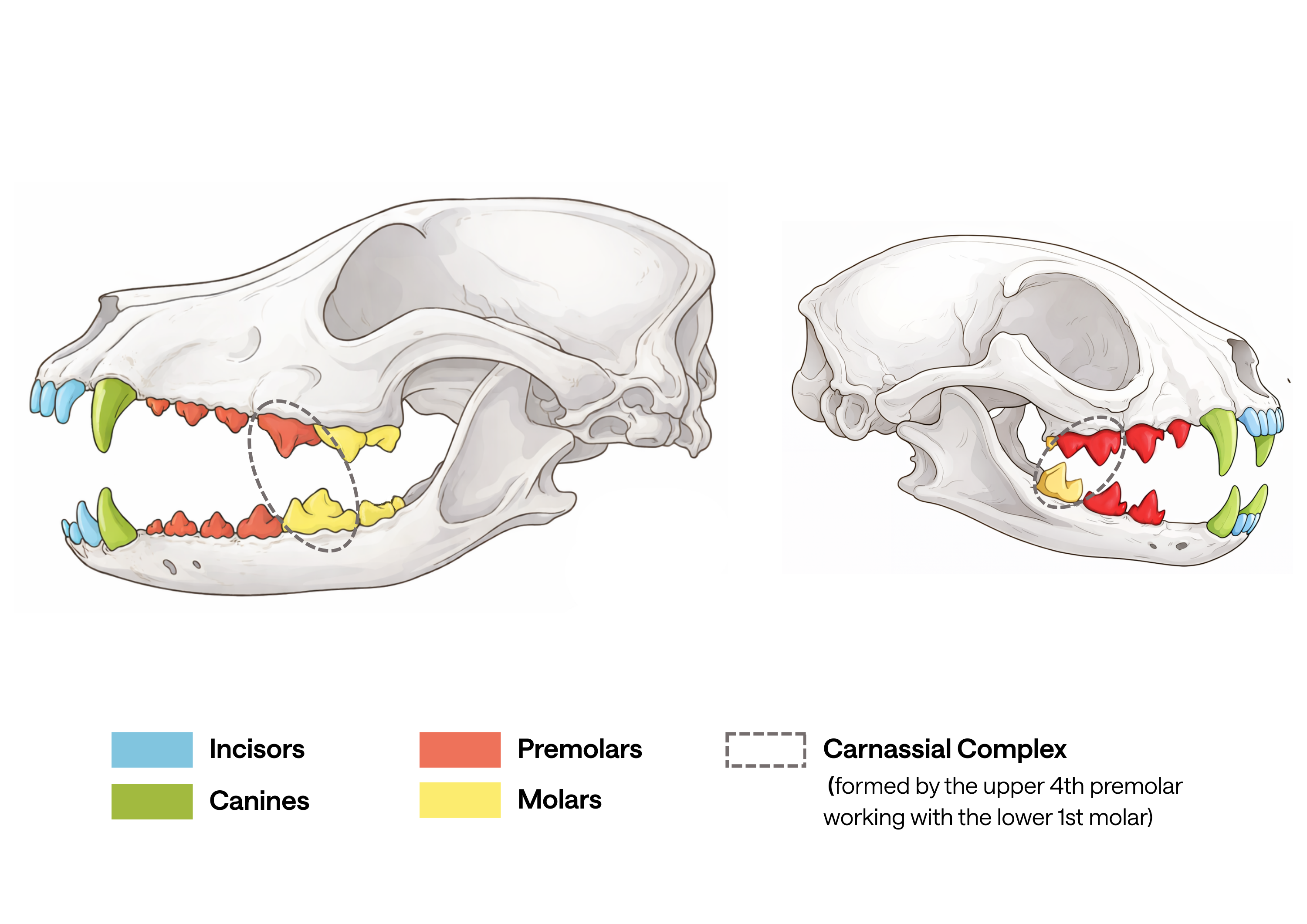
Canine Teeth - Gripping and Tearing
Canines are the long, pointed teeth designed for gripping, piercing and stabilising food. Their shape and strength allow dogs and cats to hold food securely, helping anchor it while other teeth cut or crush it into manageable pieces.Incisor Teeth - Nibbling, Scraping and Grooming
Incisors are the small teeth at the front of the mouth. They are used for nibbling food, scraping small pieces of meat from bone, and grooming the coat. Although small, they play an important role in precise food handling.Carnassial Teeth - Specialised Cutting Teeth
Carnassials are large, blade-like teeth that function like scissors. They shear meat, connective tissue and bone into swallowable pieces. This powerful cutting action is created by the upper fourth premolar working against the lower first molar.This carnassial pair is a defining feature of carnivorous mammals and plays a key role in efficiently processing animal tissue.Premolar Teeth - Tearing and Shearing
Premolars sit behind the canines and help grip, tear and shear food. Their sharp edges assist in breaking down meat, connective tissue and softer bone, working alongside the carnassial teeth during feeding.Molars - Crushing and Breaking the food
Molars sit at the back of the mouth and help crush firmer material such as bone or cartilage. In dogs they assist with breaking down tougher pieces of food, while in cats they are smaller and play a more limited role.How Carnivorous Teeth Work Together
Dogs and cats use their teeth as a coordinated system rather than for prolonged chewing. Food is gripped, cut and broken into swallowable pieces through a strong vertical jaw motion that creates a scissor-like action during feeding.
This design reflects a carnivorous feeding strategy adapted for processing animal tissue and bone.
Individual chewing style, age, dental health and confidence with bone will influence how different teeth are used.
How Carnivorous Teeth support Dental Health
Periodontal disease is one of the most common health issues in companion animals (2). Dental disease develops when plaque accumulates and hardens into tartar, irritating the gums and supporting bacterial growth.
Mechanical chewing action plays an important role in maintaining oral health. Studies have shown that chewing appropriate raw bones can significantly reduce calculus and improve dental scores in dogs (4).
Food texture strongly influences how the teeth are used. Many commercial diets require relatively little chewing, providing limited mechanical cleaning action. In contrast, firmer foods such as raw meaty bones encourage the natural feeding sequence — gripping, tearing, shearing and chomping — engaging multiple teeth and supporting oral function (3,4).
Appropriate chewing items — particularly raw meaty bones — can help support dental health by:
✔ mechanically removing plaque
✔ massaging and stimulating the gums
✔ supporting jaw strength and muscle tone
✔ encouraging saliva production
✔ engaging the full dentition
✔ satisfying natural chewing behaviours
Observations of wild carnivores show that tearing flesh and processing bone naturally help clean teeth and maintain oral health (5), behaviours that are also observed in domestic dogs and cats.
A Species-Appropriate Approach to Dental Health
A species-appropriate diet that includes appropriately sized raw meaty bones works with the natural design of carnivorous teeth, encouraging the mechanical chewing action that supports oral health.
Understanding how carnivorous teeth function highlights the remarkable anatomy of these animals and helps pet guardians make informed choices that align with their pets’ biological design.
References
Evans, H. E., & de Lahunta, A. (2013). Miller’s Anatomy of the Dog (4th ed.). Elsevier.
Harvey, C. E. (2012). Periodontal disease in dogs: Etiopathogenesis, prevalence, and significance. Veterinary Clinics of North America: Small Animal Practice, 42(4), 739–749.
Logan, E. I., Finney, O., & Barkley, M. (2010). Influence of diet on periodontal health in dogs and cats. Journal of Veterinary Dentistry, 27(2), 74–82.
Marx, F. R., Machado, G. S., Pezzali, J. G., et al. (2016). Raw beef bones as chewing items to reduce dental calculus in Beagle dogs. Australian Veterinary Journal, 94(1–2), 18–23.
Van Valkenburgh, B. (2007). Deja vu: The evolution of feeding morphologies in the Carnivora. Integrative and Comparative Biology, 47(1), 147–163.
Raw Essentials | Wildly Good Advice & Nutrition

New Zealand's raw pet food experts
Locally sourced frozen raw pet food
Natural treats and freeze dried pet food
17 pet friendly stores across New Zealand
Nationwide raw pet food delivery
[email protected]
Copyright Raw Essentials Limited. All rights reserved.
RAW ESSENTIALS | Wildly Good Advice & Nutrition
New Zealand's raw pet food experts
Frozen raw, treats and freeze dried pet food
17 pet friendly stores across New Zealand
[email protected]
Copyright Raw Essentials Limited. All rights reserved.